Cyber risk quantification is evolving.
For years, CRQ helped security leaders express cyber risk in financial terms. That remains important — but it is not enough.
Today’s challenge is making quantified risk credible, current, and actionable enough to guide real decisions: what to fix first, where to invest, what risk to accept, and when to accelerate mitigation.
According to Gartner, CRQ is moving from financial risk reporting into operational decisions.
Why traditional CRQ falls short
The issue is not that CRQ lacks analytical rigor.
The issue is operational.
Quantified assessments often become disconnected from the dynamic realities that impact organizational risk : active attack paths, changing exploitability, security control effectiveness, and operational context. When that happens, risk numbers may look precise — but they do not necessarily help leaders make better decisions.
Gartner identifies false confidence as the biggest adoption risk: quantified outputs built on weak scenarios, incomplete evidence, or unvalidated assumptions can mislead prioritization, investment, and risk treatment decisions.
What makes CRQ relevant
CRQ becomes more valuable when it is grounded in operational evidence with real time context.
That means continuously refreshing quantified outputs with:
Threat-informed scenarios
Exploitable attack path analysis
Exposure validation
Control effectiveness
Current operational data
This shifts CRQ from a periodic reporting exercise to a living decision-support factor.
The goal is not perfect precision. The goal is effective, faster, defensible decisions.
What operationalized CRQ enables
When CRQ is connected to real organizational exposure and business impact, it helps security leaders move beyond severity scores, maturity ratings, and qualitative heat maps.
It enables prioritizating operational actions in context: CRQ Identifies which vulnerabilities chained on likely exploitable attack paths materially affect probable business loss.
It supports investment decisions by comparing actions based on expected loss reduction, cost, timing, and operational constraints.
It strengthens risk acceptance by making assumptions based on evidence with explicit trade-offs and effort estimations.
And it sharpens remediation actions by helping teams focus on the gaps that meaningfully change risk outcomes — not just the ones that appear highest on a CVE severity list.
Where Cye fits
Cye’s inclusion as a Representative Provider reflects a broader market shift: CRQ must be operational in order deliver value to organizations.
This has been Cye’s approach from the get-go. CRQ is not the end goal. CRQ is a means to an end:
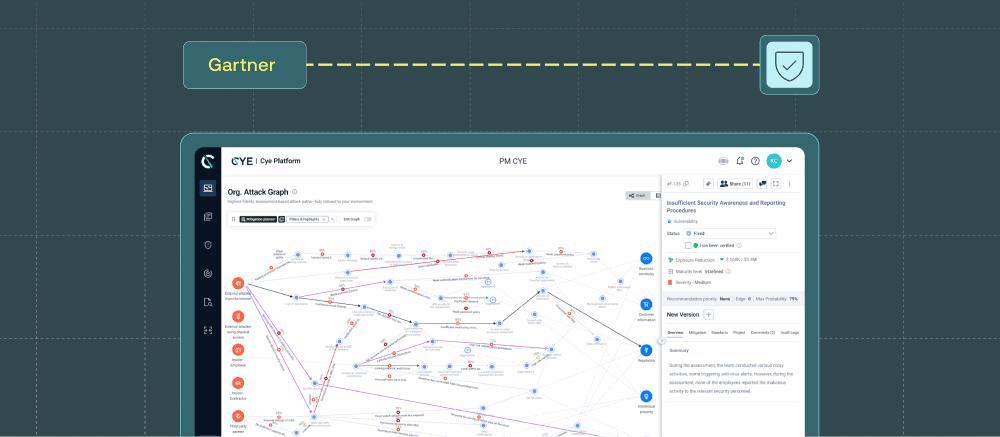
Cye’s AI-native platform helps organizations connect quantified cyber risk to validated exposure, attack paths, control effectiveness, and business impact—so teams can move from reporting risk to acting on what to remediate, mitigate, or consciously do nothing.
For security leaders, that means moving beyond activity metrics and static assessments toward measurable exposure reduction and actions operationalized to the respective teams across the organization, driving operational accountability.
Bottom line
Cyber risk quantification is not failing. It is maturing.
The next phase of CRQ is not about producing more sophisticated models or better-looking reports. It is about helping organizations make better action-based decisions with material impact on effective risk management.
That is how organizations move from risk reports to operations — with clarity they can act on and confidence they can prove.
Want to see operationalized CRQ in action? Schedule a demo with the Cye team today to learn how we translate exposure and attack paths into defensible business decisions.
Gartner Disclaimer: Gartner does not endorse any vendor, product or service depicted in its research publications, and does not advise technology users to select only those vendors with the highest ratings or other designation. Gartner research publications consist of the opinions of Gartner's research organization and should not be construed as statements of fact. Gartner disclaims all warranties, expressed or implied, with respect to this research, including any warranties of merchantability or fitness for a particular purpose.
Questions
Cyber risk quantification is the process of estimating the likelihood and financial impact of defined cyber threat scenarios to support business decisions.