The real question isn't what AI can do. It's what security teams can trust it to do.
Cybersecurity has never had more data. Yet deciding what to do with it remains remarkably difficult.
Security data now spans every layer of the enterprise, but turning it into a meaningful decision still requires connecting the dots - understanding context, weighing priorities, choosing what to change and measuring the impact.
Much of that time-consuming, resource-intensive work happens behind the scenes. And increasingly, AI agents are taking it on.
The question, then, isn't simply what AI can do. It's what security teams can trust it to do.
The security decision gap
The challenge becomes harder as security environments grow more complex. Security teams must continuously weigh technical severity against asset criticality, exploitability, existing controls, business impact and the actions already underway.
A critical vulnerability on an internet-facing production database, for example, can demand a very different response from the same vulnerability on an isolated test machine. The technical severity may be identical. The business implications are not.
Check Point's 2026 Exposure Gap Report found that only 7.8% of vulnerability alerts were validated as both exploitable and Critical or High. The vast majority of findings therefore require context and validation before teams can determine what genuinely demands immediate attention.
Doing this consistently across an enterprise requires significant analysis, judgment and coordination — and much of that work is still done manually.
Aon describes this as an executive decision gap: organizations have more cyber data than ever, but still struggle to connect that data to business outcomes and turn it into clear decisions about what risk to retain, where to invest and what requires action.
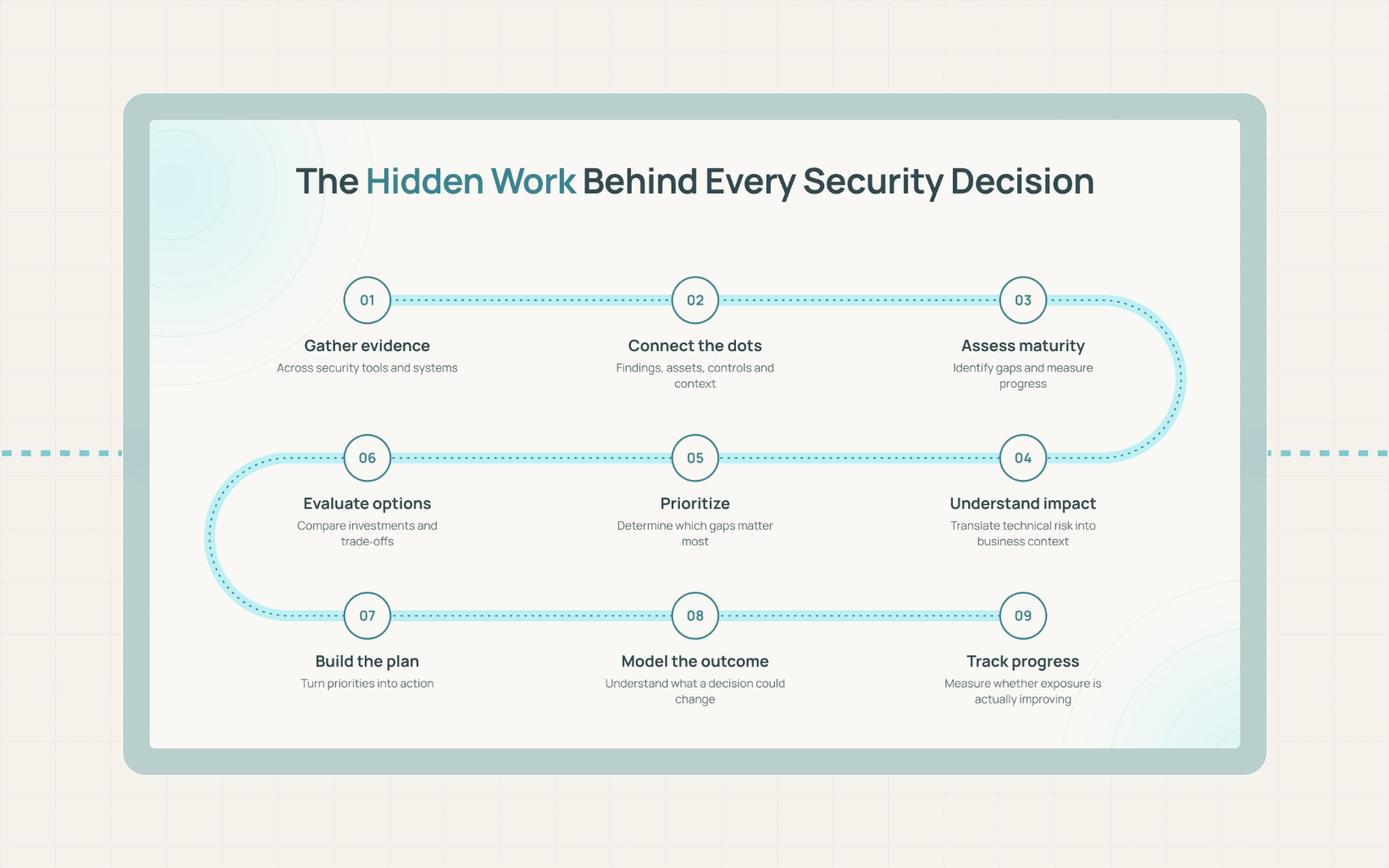
The result is a layer of work that sits between having security data and knowing what to do with it — reconciling information, weighing competing priorities, evaluating options and tracking whether decisions actually reduce exposure. This is the hidden work of cybersecurity.
AI agents are taking on the hidden work
This is where AI agents are different from the AI assistants and chatbots that came before them.
A chatbot answers a question.
A copilot helps you perform a task.
An AI agent can work through a multi-step process toward an outcome — using data, context and defined tools along the way.
The NCSC (National Cyber Security Centre) describes agentic AI as systems that can access data, retain context, make decisions, use tools and take actions toward a goal. It also cautions that greater autonomy brings greater potential impact if something goes wrong.
In cybersecurity, that opens up a much more interesting possibility.
An AI agent could take security evidence, understand what it relates to, identify gaps, assess their significance, model different options and help a security team decide what to do next.
Instead of asking AI to give you an answer, you're asking it to help move the work forward.
That's a fundamental shift.
And it explains why the most valuable AI agents may not be the ones making the most noise. They may be the ones quietly taking over the work that sits between insight and action.
What can AI agents actually do for security teams?
The potential goes beyond generating answers or summarizing information. AI agents can take on multi-step tasks, using data, context and connected tools to work toward a defined outcome.
Gartner describes agentic AI as software designed to independently make decisions and take actions to achieve specific goals, combining capabilities such as planning, memory, environmental awareness and tool use.
For security teams, that could mean agents helping to:
Gather and connect: Bring together information from different security systems and sources.
Analyze: Interpret that information in context and identify patterns, gaps or anomalies.
Assess and prioritize: Evaluate what matters most based on risk, context and business priorities.
Plan: Translate findings into potential actions and next steps.
Evaluate options: Model different approaches and their potential impact.
Track and adapt: Monitor what changes and adjust actions as circumstances evolve.
The important shift is from AI that helps answer questions to AI that can carry work forward — reducing the manual effort between identifying an issue and deciding what to do about it.
But how much can we trust AI agents in cybersecurity?
The promise of AI agents is greater autonomy. But autonomy without trust is a liability.
A 2026 survey of 100 CISOs, deputy CISOs and security directors by Strike48 found that 52% said they don't trust AI-agent outputs enough to let agents act autonomously, while 64% reported three or more trust concerns. Those concerns included unintended actions, hallucinations and agents acting on incomplete or incorrect data.
That's not resistance to AI. It's a recognition that cybersecurity is different from many other AI use cases.
If an AI agent writes the wrong marketing email, someone can fix it. If an AI agent misunderstands a security environment, prioritizes the wrong exposure or takes an unintended action, the wrong risk gets prioritized, critical exposure goes unaddressed, or resources are directed away from where they are most needed.
The NCSC's guidance makes the same point: organizations should understand what an agent can access and influence, maintain visibility into its operation, and retain meaningful human oversight and control.
So the question shouldn't be:
How autonomous can we make an AI agent?
It should be:
What security work can we confidently give an AI agent — and what safeguards should be in place?
What makes an AI agent trustworthy?
Based on the principles Cye's experts use to govern its own AI, five things matter when security teams evaluate whether they can trust an AI agent.
Read Cye's AI Governance principles →
1. Context
An AI agent needs more than technical data. It needs enough context to understand what a finding means in the environment around it — the asset, its importance, existing controls, business impact, security posture and actions already underway.
Without that context, an agent can produce a technically accurate answer to the wrong question.
2. Control
Security teams should remain in control of consequential decisions.
That means being able to review, challenge, override or disregard an AI recommendation — and being clear about where human approval is required.
3. Transparency
Trust depends on being able to understand how an AI agent reached its conclusion.
Security teams need visibility into the data an agent uses, the outputs it is designed to produce and its limitations.
For security decisions, traceability matters as much as intelligence.
4. Protection
Security data is sensitive by definition. An AI agent working with exposure data, security controls and business context needs clear boundaries around how that information is accessed, processed and protected.
5. Validation
AI shouldn't be trusted simply because its output sounds convincing.
Its performance needs to be tested, monitored and governed over time. That includes evaluating how it performs, identifying failures and monitoring its behaviour as it operates.
Because trust isn't established once and left alone.
It's an operating model.
The AI partner, not the AI decision-maker
The point of trusted AI isn't to replace security expertise with an autonomous machine. It's to give security teams an AI partner that can take on more of the work behind their decisions - while keeping people in control of the decisions that matter.
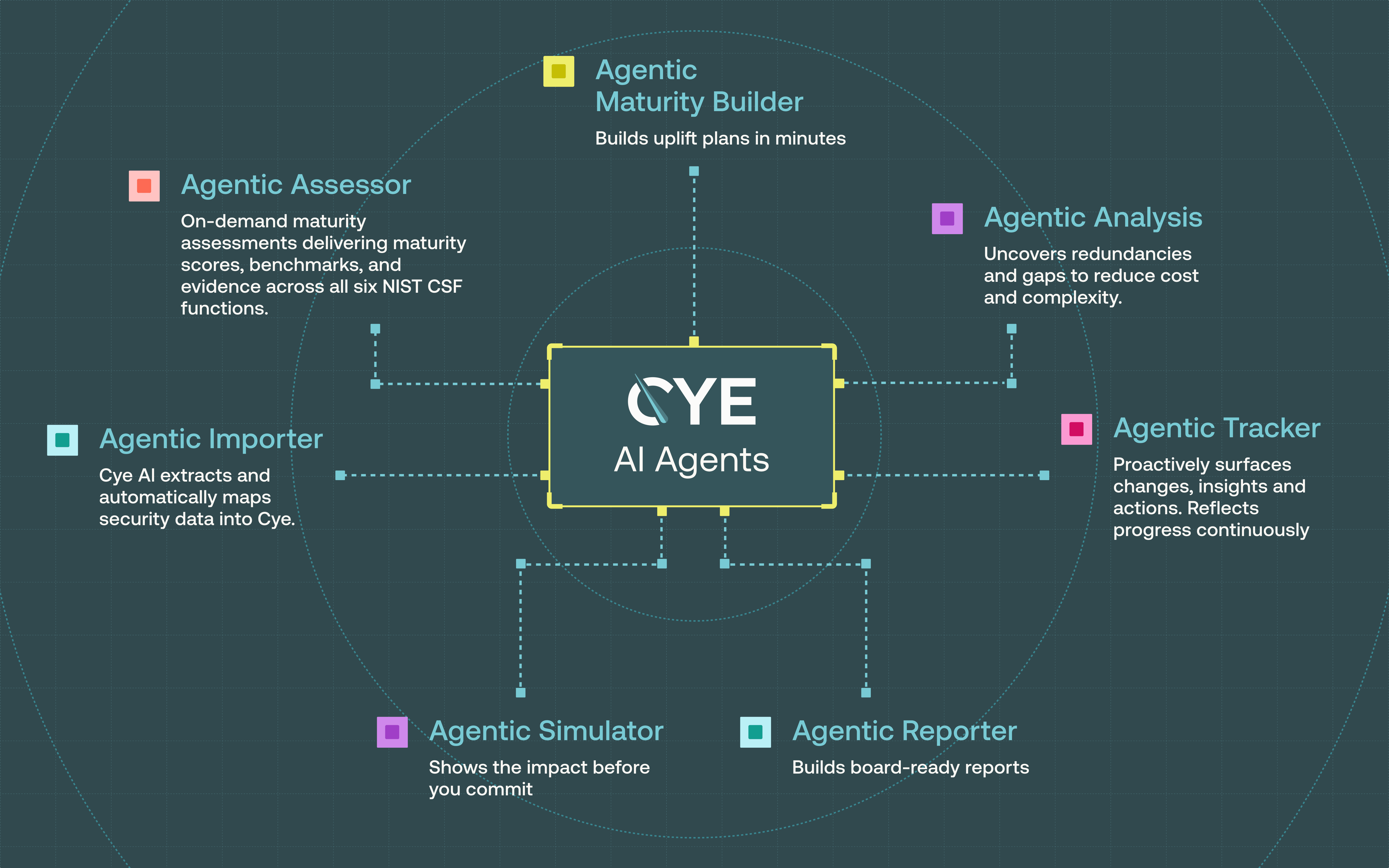
That's the approach behind Cye's connected AI agents. Each agent is designed for a different part of the cyber exposure reduction process, from assessing maturity and structuring security data to building improvement plans, analyzing the security stack, simulating decisions and tracking progress.
“SHL Medical stakeholders described Cye AI as a trusted ‘sparring partner’ for cyber strategy, risk prioritization, maturity planning, and what-if analysis.”
Dietmar Bettio, CDTO, SHL Medical
These agents operate within Cye's AI governance framework, with human oversight, clear identification of AI-generated outputs, security and privacy controls, and ongoing testing and monitoring.
But the real value comes from connecting the work.
An assessment can identify a gap.
An agent can help turn that gap into a plan.
A simulation can show what that plan could achieve.
And ongoing analysis can help determine whether the situation is actually improving.
The result is a dramatically shorter path from understanding the problem to deciding what to do, taking action and seeing whether it actually reduced exposure.
This shift towards AI that takes work off people’s hands is gaining momentum beyond cybersecurity. Meta’s Muse, described as “the world’s first personal AI agent built for everyone,” is designed to handle tasks across connected apps, from booking travel to making reservations.
The applications are different, but the direction is the same: AI moving beyond answering questions to carrying out work. In cybersecurity, that work is more consequential. Agents need to do more than complete tasks; they need the context, safeguards and human oversight to help organizations reduce risk safely.
The Future of Cybersecurity: AI Agents You Can Trust
AI agents have the potential to take on a significant amount of the hidden work behind cybersecurity decisions - gathering and connecting information, analyzing it, assessing options, planning action and tracking the results.
That can give security teams more capacity to focus on the decisions that require human judgment - and ultimately help organizations reduce exposure faster and more effectively.
But the more responsibility we give AI agents, the higher the bar for trust.
They need the right context. Clear boundaries. Human oversight. Strong protection. And continuous validation.
The future isn't AI replacing security teams. It's security teams working alongside AI agents they can trust to take on the hidden work of reducing exposure - from understanding risk and planning action to measuring the results.
Talk to an expert to learn more about Cye’s connected AI Agents →
Frequently Asked Questions
AI agents in cybersecurity are AI systems that can perform multi-step security tasks using organizational data, context and defined workflows. Unlike traditional chatbots, they can analyze information, make recommendations, plan actions and help move a security workflow toward an outcome.