Picture a researcher late at night, a grant deadline only hours away. The dataset is too large to email, so it goes into a personal cloud folder. The analysis is slow, so a few paragraphs of unpublished results are passed into a free AI assistant. None of it feels reckless. It feels like doing the job.
At the same moment, across campus, a small cyber-security team sees the same actions from the other side: a large dataset leaving the network for a personal cloud account, and unpublished research flowing to an AI service the university has never reviewed. To them, it looks like data exfiltration. They check their playbooks and weigh whether to block the account, while trying to protect thousands of people who are each, quite reasonably, focused on their own work. Both sides act in good faith, and both are protecting something they care about.
That quiet tension sits at the heart of every university: the same late-night shortcut is ordinary research to one person and a possible breach to another.
Openness is what makes academic life valuable, and it is also what makes it attractive to attackers. So how do we keep one without losing the other?
Why this matters now
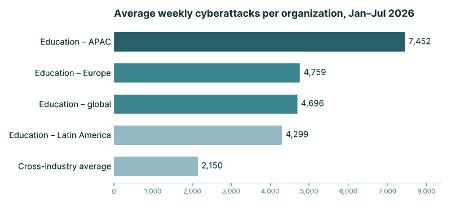
Education is the most attacked sector in the world. In July 2026, education organizations faced an average of 4,848 attacks per week; from January to July, the sector saw about 70% more attacks than government, the next most targeted sector, and attacks in Europe rose 18% year over year. In the UK, 98% of higher education institutions identified a breach or attack in the latest government survey.
The consequences reach research itself. In the 2023 University of Manchester incident, the affected data reportedly included records of about 1.1 million NHS patients held for research. In February 2026, Sapienza University of Rome, Europe's largest university by on-campus enrolment, took its systems offline after a cyberattack. In the most severe case, Lincoln College in Illinois closed in 2022, citing a ransomware attack alongside pandemic-related financial strain.
Freedom has always included responsibility
We often frame this as freedom versus control. A more useful framing is that security protects freedom. The 1997 UNESCO Recommendation protects the right to teach and research without interference, subject to accepted professional principles, including professional responsibility. Christine Borgman made the link explicit in 2018: protecting research data and research in progress is part of protecting academic freedom itself.
The risk is also shared. Phishing remains the main entry point for UK universities, and misuse of compromised accounts is the most frequent outcome. One unpatched lab server or shared password can expose colleagues, students and research participants who never made that choice. Freedom for one person should not quietly reduce the freedom and safety of others.
AI: the wish to use versus the risks
AI brings the same tension in a new form. In 2026, 95% of UK undergraduates report using AI, and use among researchers rose from 57% in 2024 to 84% in 2025. The benefits are real: almost half of students say AI has improved their experience.
Provision has not kept pace. Only 38% of UK students say their institution provides AI tools, and 70% of researchers use freely accessible ones. Across organizations generally, about 1 in 43 AI prompts in August 2026 carried a high risk of exposing sensitive data.
When use is close to universal, a ban is unlikely to work and may push AI out of sight. Approved tools and clear guidance on what may be shared are a more realistic path.
A balance that respects both
The principle is simple: keep the campus open by default, and scale protection to what the work requires. Laboratories apply the same logic to physical safety, where controls increase with the hazard. In practice, that could mean four data classification levels:
Open (published work, teaching materials): basic account hygiene and multi-factor sign-in; any AI tool.
Internal (drafts, administrative data): managed accounts, sharing controls and backups; approved AI tools.
Sensitive (personal data, unpublished results): role-based access and encryption; no sensitive data in public AI tools.
Restricted (health or export-controlled research): dedicated secure environments; AI limited to act contained inside them, if at all.
This approach fits frameworks many institutions already use, and those frameworks overlap more than they compete. ISO/IEC 27001:2022 formalizes data classification in control 5.12; NIST CSF 2.0 adds a Govern function for strategy, roles and oversight; NIS2 covers research organizations and lets member states extend it to universities that carry out critical research; and the EU AI Act asks organizations using AI to support AI literacy among their staff. One well-run program can serve all four.
What each group can do
Academic leadership (rectors, deans, boards): set the institution's risk appetite, treat cyber resilience as research infrastructure, and fund approved AI tools.
Researchers and faculty: classify your data early, use institutional platforms for sensitive work, and check a tool's suitability before pasting data into it.
CISOs and security teams: design controls around the data levels so most people rarely meet friction, and offer secure alternatives before restricting a tool[HS5] . Raise awareness, open communication channels for advisory and proper usage tips.
Risk and compliance (DPOs, auditors): link participant-data obligations to the data levels and extend impact assessments to AI tools.
ALSO RELEVANT TO: Research funders can recognize security costs as eligible research expenses. Students benefit most from simple habits such as multi-factor sign-in. IT staff at research institutes find an approved-tools list far easier to support than an unknown mix of services.
What we thought then, and where we are now
None of this is new. In 2016, The Conversation called this a real balancing challenge on campus, and network monitoring introduced across the University of California without faculty involvement caused a significant faculty backlash. What has changed is the scale of the threat, the maturity of approaches such as zero trust, and the arrival of AI. The field is reaching the same conclusion: in 2026, EDUCAUSE practitioners discussed enabling AI innovation while protecting privacy.
One cannot live without the other
Academic freedom and cyber safety are not competing values. Freedom gives security its purpose, and security keeps that freedom durable. The balance will never be fixed once and for all, but it works best when leaders, researchers, security and compliance teams draw the lines together.
Calls for academic freedom create two recurring challenges that I encounter almost on a daily basis: one common to all organizations and another shaped by the distinctive nature of universities and the arts and sciences.
The first arises when a university seeks advice or approval before adopting a new practice or technology, not only AI, by the way. For example, the usage of a pdf converting service that is needed for the administration office and requires review if it stands in various regulatory constraints and data protection requirements.
The second arises when implementation proceeds without consultation. Once the change is discovered and containment begins, academic freedom may be invoked as a blanket exemption, leaving security teams to devise creative solutions with little or no budget. For example, when a department decides to purchase its own AI license or use an open-source password manager, instead of using the university’s license in both cases.
The goal is to shift the conversation from “The risk is too high to approve this request” to “We can approve it with appropriate conditions and safeguards.” This requires helping non-technical stakeholders, including senior leaders, to see that collaboration and clear boundaries protect both their interests and the institution’s.
How does your institution find that balance?